

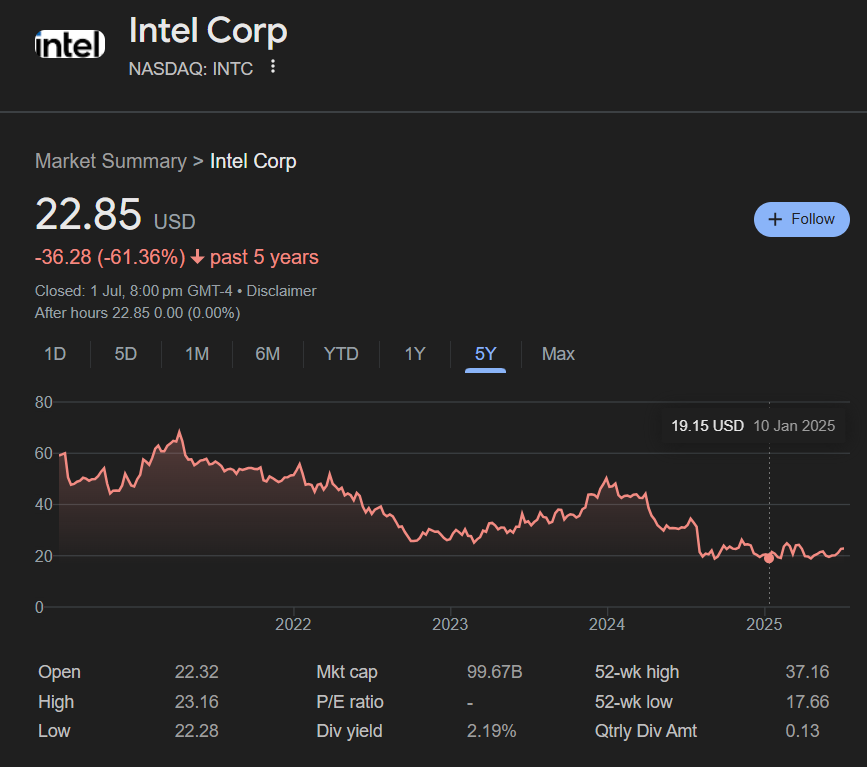
Intel Stock: The Breaking Facts Global markets reacted swiftly as **Intel Stock** experienced one of its steepest single-day selloffs in recent memory, shedding roughly 20% of its valuation. The dramatic downward spiral came in the wake of third-quarter financial results that initially topped Wall Street estimates, only to be completely overshadowed by a deeply pessimistic fourth-quarter outlook. Sluggish demand within the traditional personal computer sector, combined with broader macroeconomic headwinds and intensifying competitive pressures across the semiconductor ecosystem, sent shockwaves through major indexes.
Analysts note that trading volume for Intc Stock surged to multi-month highs as institutional investors reassessed their exposure to legacy hardware manufacturers. Market participants pointed to a confluence of negative catalysts, including persistent supply chain friction, shifting capital expenditure priorities toward artificial intelligence infrastructure that temporarily bypassed certain legacy product lines, and compounding regional manufacturing disruptions.
Background & Timeline of Intel Stock Tracing the recent trajectory of **Intel** reveals a turbulent period for heritage chipmakers trying to pivot toward modern foundry services and advanced AI accelerators. Throughout the preceding quarters, the corporation attempted to stabilize its core manufacturing margins while executing a costly multi-year turnaround strategy. However, soft consumer demand for PCs severely impacted unit shipments, leaving downstream channels oversupplied and forcing management to issue forward-looking guidance that fell well short of consensus Wall Street expectations.
As the broader technology sector faced a wider valuation correction, trading desks reported heavy liquidation across multiple semiconductor equities. Competitors such as Advanced Micro Devices also experienced sympathetic pullbacks, underscoring how deeply integrated supply expectations remain across the entire processor landscape.
Contextual Analysis & Associated Developments Beyond cyclical weaknesses in consumer hardware, structural shifts in enterprise technology spending have added further complexity to the valuation dynamics of **Intel Stock Price**. While massive capital is currently flowing into specialized AI graphics processors and data center accelerators, parts of the legacy client computing division have struggled to capture equivalent growth momentum.
Compounding these commercial headwinds, unexpected operational hurdles—including reports of localized facility incidents at key international manufacturing sites—have introduced fresh concerns regarding production continuity and yield optimization. Financial institutions quickly adjusted their valuation models, with several major investment banks slashing their 12-month target prices to reflect a more conservative growth profile.
Official Statements & Key Reactions Corporate leadership addressed the disappointing forward guidance during an emergency investor call, emphasizing that near-term headwinds in the PC market do not alter the long-term viability of their foundry transformation roadmap. Executives highlighted that inventory correction cycles across original equipment manufacturers are expected to normalize by mid-year, paving the way for gradual margin recovery.
Wall Street analysts offered mixed reactions to the management commentary. While some commended the transparency regarding structural restructuring costs, others warned that execution risks remain elevated given the aggressive capital expenditures required to compete effectively in both advanced packaging and leading-edge node development.
Strategic & Long-Term Ramifications The dramatic market repricing serves as a stark reminder of the volatility inherent in capital-intensive technology sectors. As institutional funds reallocate capital toward firms directly monetizing generative artificial intelligence, heritage chip producers face mounting pressure to accelerate product innovation and secure external foundry customers.
The ability of leadership to execute its turnaround plan without sacrificing balance sheet integrity will dictate whether current valuation levels represent a temporary cyclical trough or a more permanent structural re-rating for the enterprise.